
Feeling Trapped or Feeling Grateful?
On wearing all the hats at once


“Why don’t you take the bicycle?”
A few weeks ago, my almost fourteen-year-old son looked at me as I was scheduling a taxi to the gym. Streets covered in snow. No winter tires on the car yet.
“What a good idea!” I heard myself say as I pressed the cancel button.
His face lit up, then clouded with doubt once we found out the bicycle wasn’t in the garage but parked under the backyard stairs, blocked by the car. “Just take a taxi. Maybe it’s too complicated,” he backpedaled.
That morning, before my son came downstairs, I’d been standing at the kitchen counter slicing cucumbers for his lunch box. My hands were moving on autopilot. Wash, slice, pack. Add the pasta container. Fold another napkin, which he never uses. My body dreaming to go back to the warm bed I had just left upstairs.
Of course I went anyway. Through the laundry room, out to the stairs, wrestling the bike through the narrow gap between car and garage wall.
My heart was already racing, and I hadn’t even mounted the bike yet. When I finally freed it and pedaled off into the grey morning, I felt like a kid again. Like I was embarking on some major adventure.
Cheeks burning from cold. Legs shaking a little. Alive.
Earlier that week, I’d started drafting an essay about coexistence, about celebrating holidays across all the countries I’ve lived in, how food bridges cultures. But when I came home from that bicycle ride and sat down to write, my fingers wouldn’t type the essay I’d planned.
That physical aliveness, the contrast between the fog of my morning routine and the exhilaration of pedaling through snow, had cracked something open. A question kept pulsing in my mind. Feeling trapped? Feeling grateful? Which one do you feel?
The coexistence that needed examining first was the one within myself.
Who was I? Spouse? Mother? Writer? Cook? How did I inhabit all my roles at once without splitting apart?
I come from a culture where mothers cook everything from scratch. Where ordering out feels like failure. Where maternal devotion is measured in how much you give up, not how much you choose. For many years I thought being a good mother meant wearing sacrifice like a badge of honor.
Some mornings, waking at 6:30 to hit the kitchen feels like moving through fog. My body protests. But even then, I know this truth. I am choosing to feed my family. And that choice, though it comes from half-asleep hands slicing vegetables, tastes like love.
Earlier this year, when my daughter started her IB program, grief and gratitude collided in my heart. I started counting. Two more years until she’s off to university. Four more years until my son follows. Then I realized what I was really asking. How little time is left before they leave the nest?
The question hit me like cold water. I gasped. Because suddenly “two more years” transformed from countdown to call. Not time to endure, but time to savor.
The arithmetic of motherhood suddenly felt precious rather than punishing. That morning on the bike, counting breaths in the cold air, I thought about counting years. Both finite. Both worth living fully.
When I pack a lunch box versus develop a recipe, I’m not two different women. I ask the same questions. What do they like? What should I avoid? Is this nourishing? Whether I’m working professionally or mothering, the methodology is the same. Only the context shifts.
As a mother, I’ve finally shed one unnecessary root, the famous “I sacrificed my life for you.”
I refuse to pass this down.
My love for my children will not come with an emotional price tag attached.
The walking palm moves toward light by growing new roots while letting the useless ones die. It doesn’t choose one identity over another but grows multiple root systems simultaneously. Spouse. Mother. Writer. Cook. Badass when necessary.
When my son suggested I bike to the gym that morning, he was actually asking something. Are you brave enough to try? Are you still cool? Can you still surprise yourself?
The answer, it turns out, was yes.
And that yes felt wonderful. Navigating snowy streets, heart pounding, feeling simultaneously scared (what if I slide and fall?) and exhilarated (I’m doing it! I’m actually doing it!.)
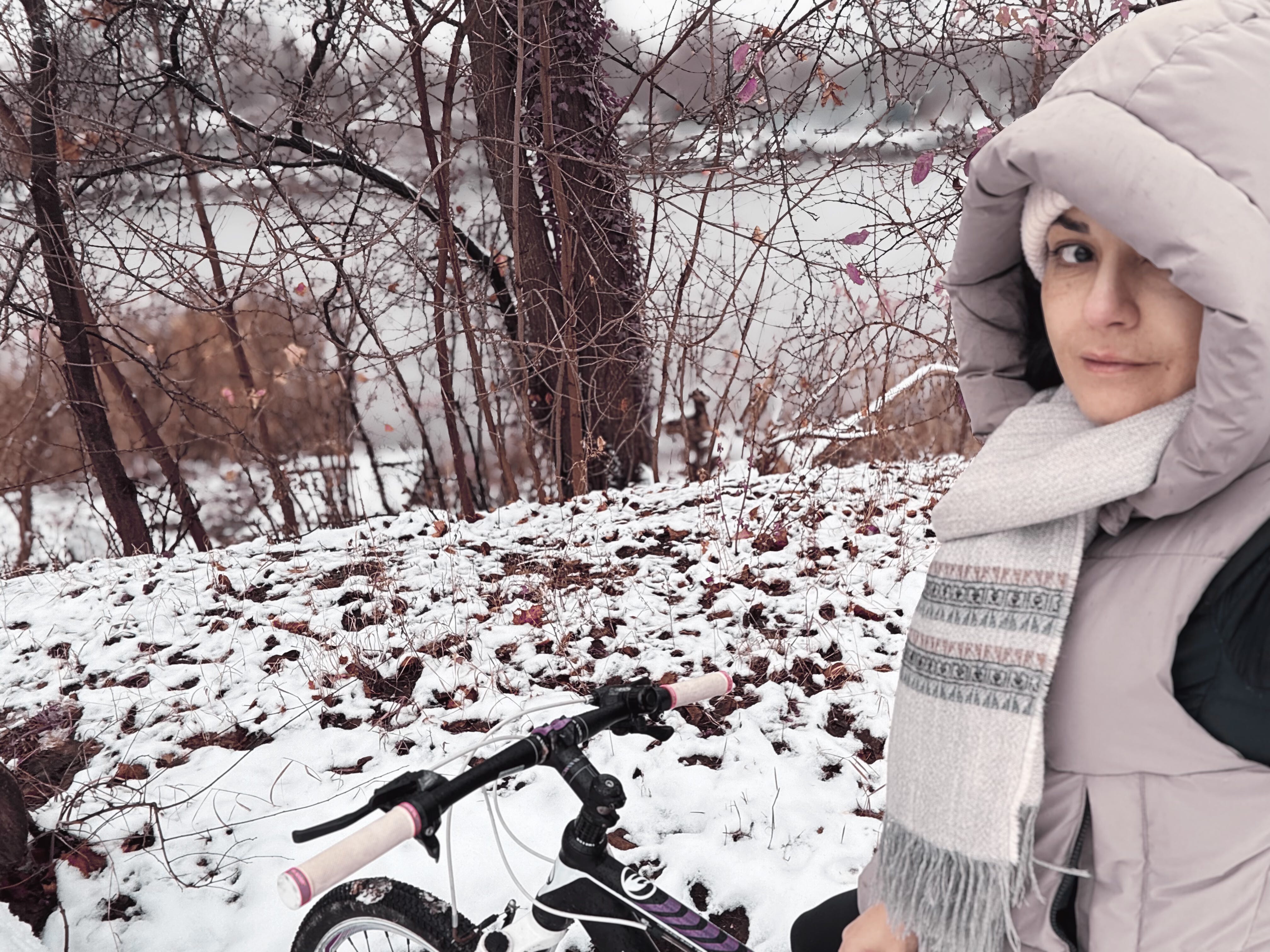
I was saying “look ma, no hands“ to myself. That wonderful childhood feeling of mastering something scary.
That’s adaptive motherhood. That’s the walking palm in badass mode. Moving toward light. Shedding old beliefs about what a good mother looks like.
I came across only one other person riding in the snow. As she biked past in the opposite direction, she smiled at me. Her eyes said it all. “Aren’t we the brave ones this morning?”
I smiled back, breathing hard, feeling the sisterhood.
This year, I’ve said goodbye to internal negotiations. I’m done negotiating between my roles. I’m wearing all the hats at once. And some days, one of those hats is a bicycle helmet on a cold November morning, pedaling through snow because my son dared me to be brave.
The many versions of myself, finally at peace with each other. Finally moving in the same direction.
Finally home.💛
Sanaa
To End on a Sweet Note
To celebrate saying yes to challenges, wearing many hats, and creating traditions that travel with us, I’m sharing my favorite red fruit tart recipe, which I’ve been making since we left Mexico in 2020.
I used to order it from Bakéa, chef-owner Vicente Etchegaray’s Basque-French restaurant, for every celebration.
I spent days reconstructing it from memory, translating taste into technique. Pâte sablée, amandine, berries, glaze and lots of love.
Hope you enjoy it!
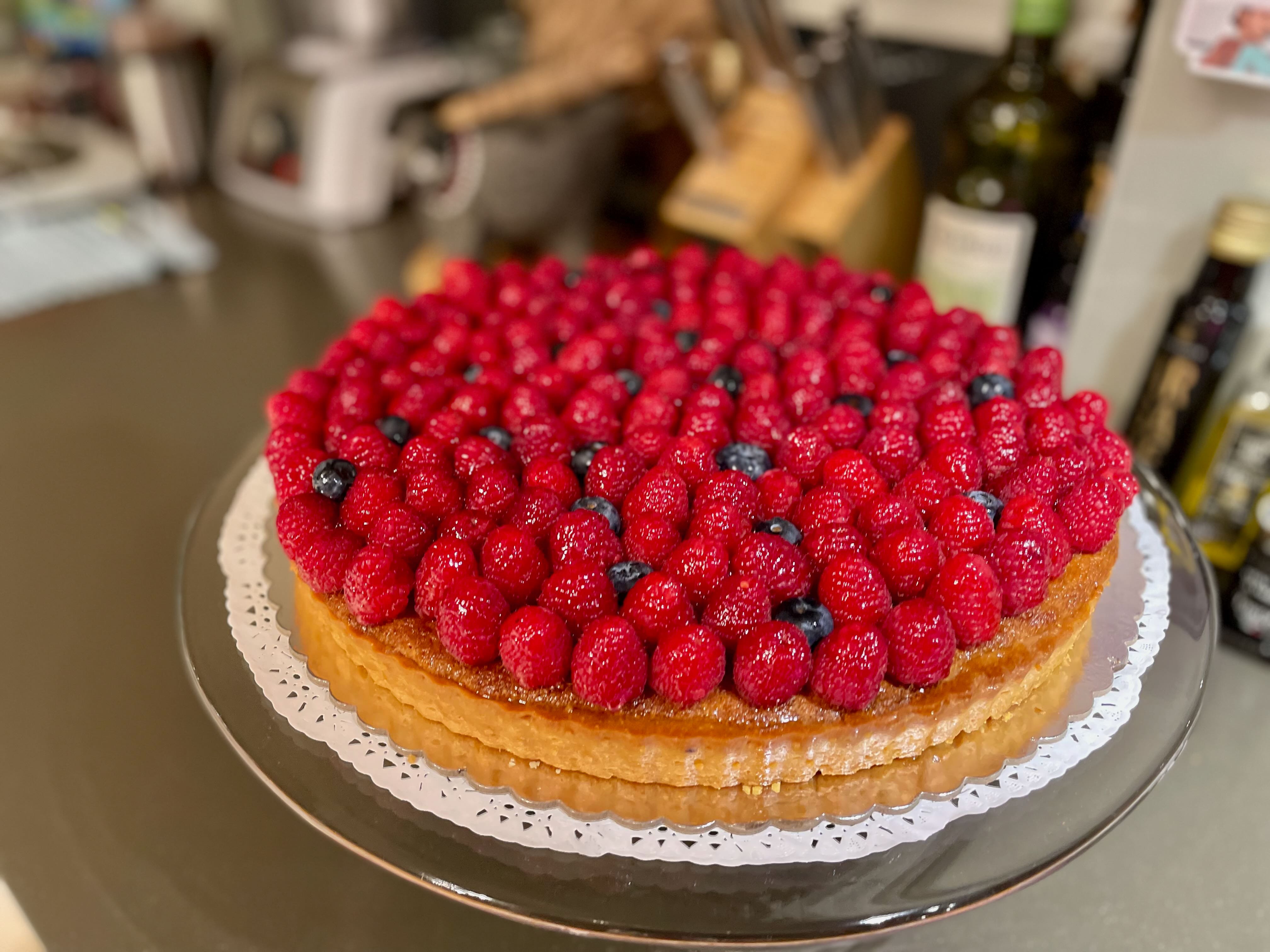
Bakéa Inspired Red Fruits Tart
Yield: 8 servings/ 28 cm removable bottom tart tin.
Ingredients
250 grams flour
100 grams confectioners’ sugar
½ teaspoon salt
6 eggs, divided (1 for the dough, 1 for the dorure, 4 for the almond filling)
325 grams soft unsalted butter, divided (125 grams for the tart and 200 grams for the filling)
2 tablespoons cream
350 grams white sugar, divided (200 grams for the filling, 150 grams for the glazing)
1 tablespoon vanilla extract
200 grams almond powder
1 tablespoon of Rhum or Rhum flavor
150 grams water
3 sheets of gelatin
About 600 grams of mixed fresh red berries (raspberries, blueberries, blackberries)
Method
Preheat oven to 170°C
To make the dough
1. Sift the flour and confectioners’ sugar into a clean flat surface. Add salt and mix with a spoon. Then, using the spoon, make a crater (a dip) in the mixture. Add 1 beaten egg in the middle of the crater and mix well. Add 125 grams of soft butter and mix all with hands. If the dough is liquid, add some flour. Form dough into a ball, wrap tightly in plastic and refrigerate for 2 hours or keep overnight.
2. Stretch the dough ball thinly into the shape of the bottomless tart mold, so that it is crispy afterwards. Fold in four so you can transfer easily into the mold. Place the angle in the center of the mold. Using your fingers, gently push the dough against the inner edges of the mold. Remove excess with a knife. Make holes with a fork, cover with film and refrigerate for at least 2 hours.
3. Bake the tart shell for 10–15 minutes.
To make the tart impermeable:
Prepare an egg wash (dorure) by combining 1 large egg with 2 tablespoons of cream. Remove the tart shell from the oven, brush with the dorure, and bake until golden. This makes the tart impermeable.
To make the almond filling (amandine):
1. Place 200 grams of sugar and 200 grams of butter in a mixing bowl and mix well with an electric mixer. Add 4 eggs one by one. Add the vanilla extract, the 200 grams of almond powder, and the Rhum (or Rhum flavor), and mix well. Cover with plastic wrap touching the surface of the amandine to avoid drying out the top of the almond cream. Refrigerate for 15 minutes. Remove from fridge and mix well again.
2. Place the almond filling inside a pastry sleeve to fill the tart shell. Flatten with a spatula. Bake for 15–20 minutes, depending on oven.
To make the neutral glaze:
1. Soak the gelatin sheets in a large bowl of cold water for 5 minutes.
2. Mix the water and sugar in a saucepan and bring to a quick boil. Remove from the heat.
3. Squeeze the water from the gelatin sheets using your fingers and add it to the pan. Whisk lightly to help it dissolve. Pour the preparation into a glass container. Let cool, cover with a plastic wrap and refrigerate. Reheat the neutral glaze before using. Apricot jam (30 secs in microwave) can be used as a shortcut.
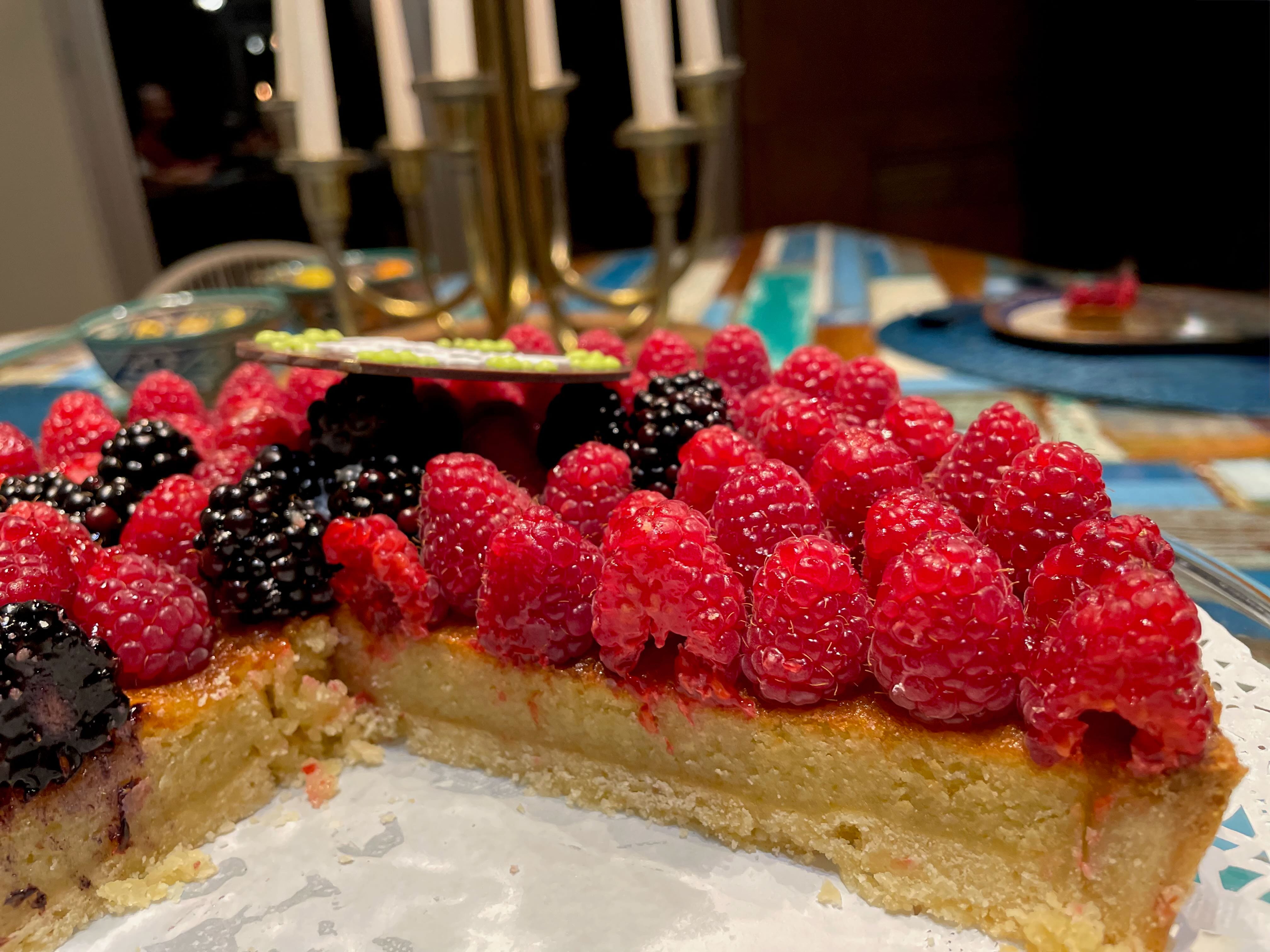
Assemblage : Gently remove the tart from the mold and place in a serving plate. Brush the top of the tart with some neutral glazing. Arrange the red fruits on the tart starting from the center and brush with the neutral glazing.
Sanaa this is triumphant. The power you claimed in that moment arose from deep inside your self. That is something to seize with both hands, as your delicious cake is too.
I wanted to restack quotes from so much of this piece. "My love for my children will not come with an emotional price tag attached." Well said, and to be honest, a little reminder I needed too! Thank you for sharing this powerful piece Sanaa